

To play a backgammon game board game successfully, two players compete on a specially constructed board consisting of twenty-four narrow triangles called points. The ultimate objective is for each player to move all fifteen of their checkers along the points according to the rolls of two dice, bring them into their designated home board, and then bear them off the board completely. The first player to clear all of their pieces from the board wins the entire game.
Navigating the strategic depths of this classic pastime involves mastering precise opening moves, defensive positioning, and advanced scoring mechanisms. Whether you are looking to learn the rules for casual recreation or seeking a reliable partner for large scale procurement of high quality gaming sets, this article delivers an exhaustive breakdown of everything you need to know. Below is an organized table of contents outlining the critical sections of this ultimate guide, followed by an in-depth analysis of each phase of the game.
Title Directory Table
Section | Summary |
What is Backgammon Board Game? | An introduction defining the backgammon game board game, exploring its historical roots, global cultural significance, and modern classification as a competitive tactical sport. |
Basics of Backgammon Board Game | A breakdown of the primary objectives, foundational equipment, essential terminology, and the core mechanics required to begin a standard match. |
Understanding Backgammon Game Board | A detailed anatomical examination of the physical playing surface, including the division of points, quadrants, the central bar, and material considerations. |
Backgammon Board Set Up | A comprehensive step-by-step physical arrangement guide detailing exactly where each checker must be placed to ensure an accurate, compliant starting position. |
Backgammon Gameplay | A deep dive into the turn-by-step sequence of rolling dice, legal movement paths, hitting opposing checkers, entering from the bar, and the final bearing-off process. |
Optional Backgammon Rules | An overview of advanced, tournament-style regulations that elevate strategic complexity, focusing on the doubling cube, crawford rule, and standard scoring multipliers. |
Top Backgammon Tips | A collection of expert strategic recommendations, covering offensive and defensive frameworks, probability calculation, and choosing commercial-grade board materials. |
What is Backgammon Board Game?
A backgammon game board game is a traditional two-player tabletop strategy game that blends tactical checker movement with the mathematical probability of rolling two dice. It belongs to the ancient family of tables games, tracing its historical lineage back nearly five thousand years to early Mesopotamian and Roman civilizations. Today, it stands as a sophisticated global competitive sport, celebrated for balancing pure strategic foresight with the unpredictable nature of random dice outcomes.
Historically, the evolution of the backgammon game board game reflects the progression of human leisure and engineering, transitioning from ancient wooden and stone layouts to contemporary luxury editions. In the commercial B2B sphere, these sets are highly valued as promotional items, educational tools, and premium retail goods. The enduring popularity of the game stems from its unique psychological dynamic: while a novice can occasionally defeat an expert due to a lucky string of dice rolls, long-term mastery always favors the player with a superior grasp of probability and positioning.
The global market for classic board games continues to expand, driven by a growing demand for tangible, high-quality entertainment options that pull people away from digital screens. A professionally crafted backgammon game board game represents more than just a set of rules; it is a physical asset that relies heavily on premium manufacturing to deliver a satisfying tactile experience. Businesses sourcing these products must pay close attention to structural integrity, precise alignment of the playing surfaces, and the aesthetic appeal of the materials used.
To better understand how this classic product positions itself against other major traditional tabletop games within the commercial market, consider the following structural and material comparison table:
Traditional Strategy Game Comparison
Game Classification | Primary Playing Mechanism | Chance Element | Structural Component Needs | Market Target |
Backgammon | Dice Roll and Checker Movement | High Probability | Inlaid Points, Precision Dice, Rolling Cups | Hospitality, Retail, Premium Gifting |
Chess | Pure Tactical Calculation | None | Grid Layout, Sculpted Figurines | Educational Institutions, Clubs |
Checkers | Linear Piece Capture | None | Two-Color Grid, Interlocking Discs | Mass Market Retail, Family Entertainment |
Basics of Backgammon Board Game
The foundational basics of a backgammon game board game revolve around moving fifteen checkers along a track of twenty-four points based on dice rolls to clear them off the board first. Each player is assigned a specific color of pieces and moves in a direction opposite to their opponent around a horseshoe-shaped track. The fundamental mechanics require players to balance offensive advances with defensive safeguards to prevent their pieces from being captured.
To engage with the game at a professional or recreational level, one must familiarize themselves with the essential terminology and component definitions that govern every match. The core components of a standard commercial set include the playing surface itself, thirty checkers divided equally between two colors, two pairs of standard six-sided dice, two dice cups designed for fair shaking, and a specialized doubling cube used for tracking escalating stakes. Understanding how these pieces interact is the first step toward developing sophisticated gameplay tactics.
For commercial buyers and distributors, analyzing the basic components reveals the importance of choosing the correct manufacturing elements. The weight, feel, and sound of the checkers sliding across the surface significantly influence user satisfaction and brand perception. When selecting products for inventory, businesses should look for sets that prioritize durability, clarity of layout, and high-quality material selection.
Essential Component Breakdown
Checker Specifications
The checkers must feature a consistent weight distribution and a perfectly flat base to ensure smooth gliding over the playing surface. Common commercial materials include high-density acrylic, urea resin, and composite plastics, which offer excellent scratch resistance and a satisfying clack when moved.
Dice and Rolling Accessories
Standard sets utilize two pairs of dice to accelerate gameplay, allowing each player to roll their own set. High-quality kits often include dice cups lined with soft felt or velour, which drastically reduces noise levels during corporate events or hospitality environments while ensuring a thoroughly randomized roll.
The Doubling Cube
This specialized six-sided die is marked with the numbers 2, 4, 8, 16, 32, and 64. Unlike standard dice, it is not rolled; instead, it serves as a visual marker to track the current point value of the match, allowing players to raise the stakes when they feel they hold a distinct positional advantage.
Understanding Backgammon Game Board
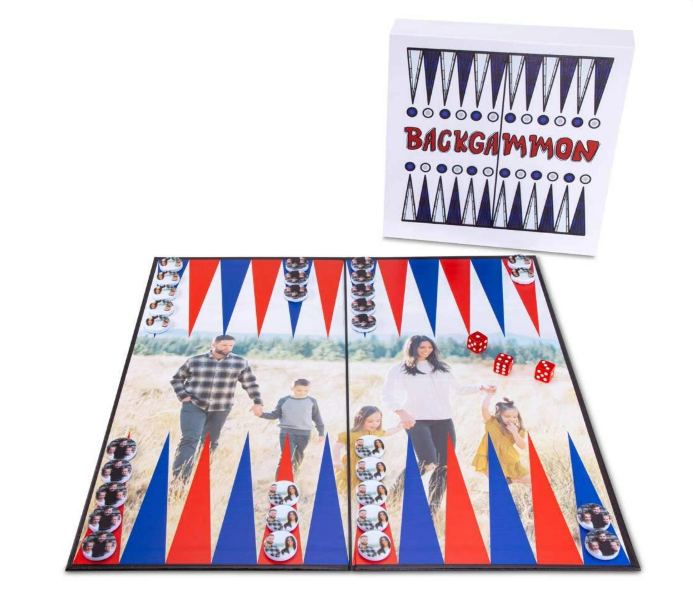
An authentic backgammon game board game features a distinct layout consisting of twenty-four narrow, alternating colored triangles known as points, split down the middle by a raised ridge called the bar. The board is physically divided into four quadrants: the player's home board, the player's outer board, the opponent's outer board, and the opponent's home board. This specific anatomical structure dictates the entire flow of movement and sets strict boundaries for legal checker placement.
The twenty-four triangles are numbered conceptually from 1 to 24 based on the perspective of each individual player. A player's 1-point corresponds directly to their deepest home board position, while the 24-point represents the furthest starting position located deep within the opponent's territory. The central bar is not merely a structural divider; it serves as a holding zone for checkers that have been struck and temporarily removed from active play.
From a product design and manufacturing standpoint, constructing a flawless playing surface requires immense technical precision. The alternating triangles must be perfectly flush with the rest of the layout to ensure that checkers do not catch or stutter during movement. Businesses interested in custom designs or bulk sourcing can explore professional options like a customized Backgammon game board game to secure custom dimensions, tailored color schemes, and premium branding options that resonate with high-end consumers.
To ensure long-term durability and structural integrity under heavy usage, manufacturers utilize diverse material layering techniques. For a comprehensive analysis of the base substrates, laminates, and textile options available in high-end manufacturing, businesses can consult Board Game Card Materials: The Ultimate Guide to understand how different compositions affect product longevity.
Board Geometry and Movement Flow
Home Board Quadrant
This critical zone contains points 1 through 6. It represents the final destination for all fifteen of a player's checkers and is the only area on the board from which pieces can be legally removed during the final phase of the game.
Outer Board Quadrant
Encompassing points 7 through 12, the outer board acts as a transitional corridor. Players must navigate this space carefully, often building temporary blockades or safe zones to protect their advancing checkers from opposing attacks.
The Central Bar
The bar runs vertically down the center of the board, separating the home and outer areas. When a single checker is left unprotected on a point and hit by an opponent, it is placed on this bar, forcing the owner to restart its journey from the furthest possible point.
Backgammon Board Set Up
To set up a standard backgammon game board game correctly, each player must arrange their fifteen checkers in a specific, universally accepted configuration across the twenty-four points. This precise arrangement guarantees an equal balance of power and vulnerability at the start of the match. For the purpose of standardization, the setup is described below from the perspective of a player moving counter-clockwise from the opponent's home board into their own.
The distribution of pieces requires careful counting to ensure complete compliance with tournament rules. Each player places exactly two checkers on their 24-point, five checkers on their 13-point, three checkers on their 8-point, and five checkers on their 6-point. This symmetrical layout creates an immediate tactical landscape filled with long-range runners, mid-board blocking groups, and heavily fortified home board positions.
For retailers and commercial distributors, providing clear, easily readable instructions regarding this setup within the product packaging is vital for customer satisfaction. Ensuring that the points are clearly defined and visually distinct prevents confusion during initial arrangement. Using high-contrast color pairings for the triangles significantly enhances the setup process for players of all skill levels.
Step-by-Step Checker Distribution
The 24-Point Position
Each player positions exactly two checkers on the furthest point of the board, located deep inside the opponent's home quadrant. These pieces are often referred to as runners because they have the longest distance to travel to reach safety.
The 13-Point Position
Five checkers are placed on the 13-point, which sits directly on the far side of the outer board, adjacent to the central bar. This heavy stack acts as a primary supply line, offering versatile options for advancing into the outer board.
The 8-Point and 6-Point Positions
Three checkers are positioned on the 8-point within the outer board, while the final five checkers are placed on the 6-point, marking the entrance to the home board. These pieces establish an immediate defensive presence, guarding the home territory right from the opening roll.
Backgammon Gameplay
The core gameplay of a backgammon game board game involves a cyclical turn sequence where players roll two dice and move their checkers forward according to the individual numerical values shown. Each turn requires a player to calculate the optimal path for their pieces, deciding whether to consolidate their forces or take calculated risks to block their opponent. The game progresses through three distinct phases: opening movement, tactical maneuvering involving captures, and the final bearing-off stage.
To initiate a match, both players roll a single die; the player who scores the higher number takes the first turn, using the combined numbers rolled by both sides as their initial movement values. On all subsequent turns, players roll their own pair of dice. A critical rule to remember is that a player can move a single checker the combined total of both dice, or split the roll between two different checkers, provided that the intermediate landing points are open.
If a player rolls identical numbers on both dice, known as a double, they are granted a significant advantage: they must play the numbers shown on the dice four times instead of twice. For instance, rolling two 5s allows a player to execute four distinct movements of five spaces each, opening up massive opportunities for rapid advancement or reinforcing key structural positions.
Tactical Gameplay Mechanisms
1. Landing on an Open Point
A point is considered open and legal to land on if it is completely unoccupied, contains other checkers belonging to the moving player, or holds exactly one checker belonging to the opponent. If an opponent has two or more checkers firmly established on a point, that point is blocked or made, and the moving player cannot land there under any circumstances.
2. Hitting and Reentering from the Bar
Leaving a single checker alone on a point creates a vulnerable blot. If an opponent lands exactly on that point, they hit the blot, placing it onto the central bar. A player with a piece on the bar cannot move any other checkers until that piece is successfully reentered into the opponent's home board via a dice roll corresponding to an open point.
3. The Bearing-Off Process
Once a player successfully gathers all fifteen of their checkers into their own home board, they can begin the process of bearing off, which means removing pieces from the playing surface entirely. Checkers are removed by rolling numbers that match the exact points they occupy, or higher numbers if no checkers remain on the outer points. The first player to clear all pieces wins.
Optional Backgammon Rules
Advanced optional regulations in a backgammon game board game introduce the doubling cube and specialized tournament scoring mechanisms to drastically elevate the strategic complexity of competitive play. These rules are designed to minimize the impact of luck over long sessions, allowing players to leverage their positional advantages to force concessions or maximize their point yields. They turn a standard race into a high-stakes psychological battle of risk management.
The doubling cube is the most influential optional tool utilized in modern club and tournament matches. At any point before rolling the dice, a player who believes they possess a clear advantage can propose to double the current stakes of the game. The opponent must then make a critical decision: they can either decline the double, instantly forfeiting the match and losing the current base point value, or accept the double, agreeing to play on at twice the original stakes.
Once a double is accepted, ownership of the physical cube shifts exclusively to the player who accepted it. This means only that player has the right to propose a subsequent redouble to four times the stakes if the tide of the match turns in their favor. This shifting ownership dynamic prevents a dominant player from continuously bullying an opponent with endless doubling demands.
Advanced Scoring and Tournament Controls
The Crawford Rule
In match play, when a player reaches a score exactly one point away from winning the entire series, the Crawford Rule is triggered for the very next game. During this specific game, neither player is permitted to use the doubling cube, ensuring that the trailing player has a fair, uninterrupted opportunity to win a standard game based purely on checker strategy.
Jacoby Rule
Commonly applied in casual money games but excluded from standard match play, the Jacoby Rule dictates that gammons and backgammons do not count for double or triple points unless the doubling cube has been actively deployed and accepted during the game, encouraging earlier use of the cube.
Gammon and Backgammon Win Multipliers
Winning Condition | Description | Scoring Outcome |
Single Win | The winner bears off all fifteen pieces before the loser, but the loser has successfully removed at least one checker. | 1x Current Cube Value |
Gammon Win | The winner clears all fifteen pieces before the loser has managed to bear off a single checker from the board. | 2x Current Cube Value |
Backgammon Win | The winner clears all pieces while the loser has no pieces cleared and still has checkers on the bar or in the winner's home board. | 3x Current Cube Value |
Top Backgammon Tips
Mastering a backgammon game board game requires a balance between offensive racing speed, defensive blocking formations, and an accurate assessment of dice probabilities. Successful players do not simply react to the immediate numbers rolled; they continuously evaluate potential risks multiple turns in advance. Implementing structured, proven tactical frameworks is essential for transitioning from a basic beginner to a highly proficient competitive player.
When developing long-term strategies, players must learn when to transition between different styles of play based on the layout of the board. Building secure points prevents your checkers from being hit while simultaneously restricting the movement options of your opponent's pieces. Understanding the fundamental strategic concepts outlined below will help you consistently outmaneuver your opponents.
For businesses looking to supply premium gaming options to consumers, selecting well-designed equipment is a crucial strategic step. Sourcing a customized Backgammon game board game ensures that the physical dimensions and structural quality match the high tactical standards expected by seasoned players. Furthermore, choosing the right production components, as detailed in Board Game Card Materials: The Ultimate Guide, ensures the board remains perfectly flat and resistant to warping over years of heavy competitive play.
Pro Tactical Frameworks
1. Establish Secure Home Board Points
A foundational strategy is to create pairs of anchored checkers on your 5-point, 4-point, and 7-point (often called the bar point) early in the match. Securing these specific positions builds a powerful blocking wall that hinders the escape of your opponent’s two deep runners while providing safe landing zones for your own advancing pieces.
2. Prioritize the Escape of Deep Runners
The two checkers starting on your opponent's 24-point face the longest journey and are highly vulnerable to being trapped. Look for early opportunities to advance them to safety in the outer board using high dice rolls or double combinations before your opponent can build a dense blocking prime around them.
3. Master the Art of Duplication
Duplication is a tactical concept where you position your vulnerable blots in a way that requires your opponent to roll the exact same number to achieve different attacking goals. For example, if you place your blots so that your opponent needs a specific 4 to hit either piece, you minimize their overall mathematical probability of success, making it safer to advance.
